Read Time: 5–6 minutes
Key Questions Answered
1. Why do people with dementia or Alzheimer’s need a special clock?
Individuals with dementia or Alzheimer's often experience disorientation regarding time, leading to confusion, anxiety, and disrupted daily routines. A specialized clock provides clear, accessible information about the current time, day, and date, helping to reduce confusion and support daily structure.
2. How do dementia clocks support daily routines and reduce confusion?
Dementia clocks, like the Dawn Clocks Digital Calendar & Reminder Clock, offer features such as large, easy-to-read displays and customizable reminders for daily activities (e.g., meals, medication, appointments). These features help individuals maintain their routines, promote independence, and reduce the need for constant supervision or prompts from caregivers.
3. What types of dementia clocks are available?
The market offers various dementia clocks, including:
-
Digital Clocks: Display time, day, and date in large, clear formats.
-
Analog Clocks: Traditional clock faces, sometimes with added features for clarity.
-
Talking Clocks: Announce the time audibly, beneficial for those with visual impairments.
-
Reminder Clocks: Include programmable alerts for daily tasks.
The Dawn Clocks Digital Calendar & Reminder Clock combines several of these features, offering a comprehensive solution.
4. What is the most popular dementia clock and why?
The Dawn Clocks Digital Calendar & Reminder Clock is highly regarded due to its user-friendly design, clear display, and customizable reminders. Its ability to provide structure and independence makes it a preferred choice among caregivers and individuals with memory impairments.
5. Are there options for people who prefer analogue or have poor eyesight?
Yes, for those who prefer analog displays or have visual impairments, options include:
-
Analog Clocks with Large Numbers: Feature bold, high-contrast numbers for easier reading.
-
Talking Clocks: Announce the time and date audibly at the press of a button.
These alternatives cater to individual preferences and specific needs.
6. How can dementia clocks help carers and families?
Dementia clocks reduce the frequency of repetitive questions about the time or daily activities, alleviating stress for caregivers. They promote autonomy in individuals with memory impairments, allowing caregivers to allocate their attention more effectively and enhancing the overall caregiving experience.
Quick Summary:
The Dawn Clocks Digital Calendar & Reminder Clock is a valuable tool for individuals with dementia, Alzheimer's, or other cognitive impairments. Its clear display and customizable reminders support daily routines, reduce confusion, and promote independence. By addressing common challenges associated with memory loss, this clock enhances the quality of life for both users and their caregivers.
Losing track of time is a debilitating issue for many people living with dementia and Alzheimer’s. No longer knowing the day - or time of the day - can be a frustrating and distressing experience. It can even disrupt sleep, eating patterns or anything to do with daily routine.
Fortunately, specially designed clocks for seniors can return that sense of structure and help keep your loved ones on top of the time. Whether it’s analogue or digital, portable or talking, we’ve put together our most popular and best clocks for people with dementia.
A memory loss clock is a simple item and a perfect way to provide safer in-home care. Take a look at our choice.

Why would your loved one need a Dementia clock?
A dementia clock is a simple solution for a growing concern. Many seniors suffer from memory loss and confusion- either from dementia or Alzheimer’s, or as a result of Parkinson's or a stroke, or just due to their advancing years.
A dementia clock isn’t just all about convenience. Individuals with memory loss use it as an anchor to their daily life. In early stages of dementia, it's easy to lose track of time. In the middle stages of dementia or Alzheimer's, a loved one may frequently drift into the past.
Activities can become increasingly frustrating as they lose track of time and day, and often confuse morning with afternoon, or worse, even confuse day with night! When your loved one loses the ability to recognise the time of day, their security is lost as well, and this can lead to a forgotten lunch or dinner, a missed doctor’s appointment or a neglected daily task.
People with memory loss thrive when their life is structured and when they are on a regular routine. Familiarity is their best friend. So, placing one – or more - of these easy-to-read reminder clocks around the home can help ease anxiety and aid with their confusion.
It has been proven that dementia clocks can make a huge impact on the independence, confidence, and efficiency of people who live with memory loss.

Many of our customers have found our user-friendly dementia clocks a great help in keeping track of time and maintaining their daily routines. We have received a lot of positive feedback from relatives of people with dementia on how this simple device has improved people’s lives. They are a bless for family carers as they are no longer being constantly asked the time of day.
A dementia clock is a great gift option for any household.
What dementia clocks are available?
There is a range of dementia clocks available on the market. To help you make a balanced choice, we have chosen our best and most popular dementia clocks.
Day and night clock
One of the problems people with dementia experience is being unable to tell from traditional timepieces whether it’s day or night – this is especially important during the winter months, when it’s dark at both 6am and 6pm.
Our dementia clock clears up any confusion, as it shows whether it’s day or night in an easily understandable way.
Dementia clock
The Dementia Clock by Dawn Clocks is our most popular choice. It is a combination of a clock, a calendar and a reminder. It is a stylish solution to the time-telling problem.
It has been specially designed to work with all forms of dementia: from the early stages – when cognition and mental abilities make it easier to take on information – to the mid and later stages of dementia – when too much information can be confusing.
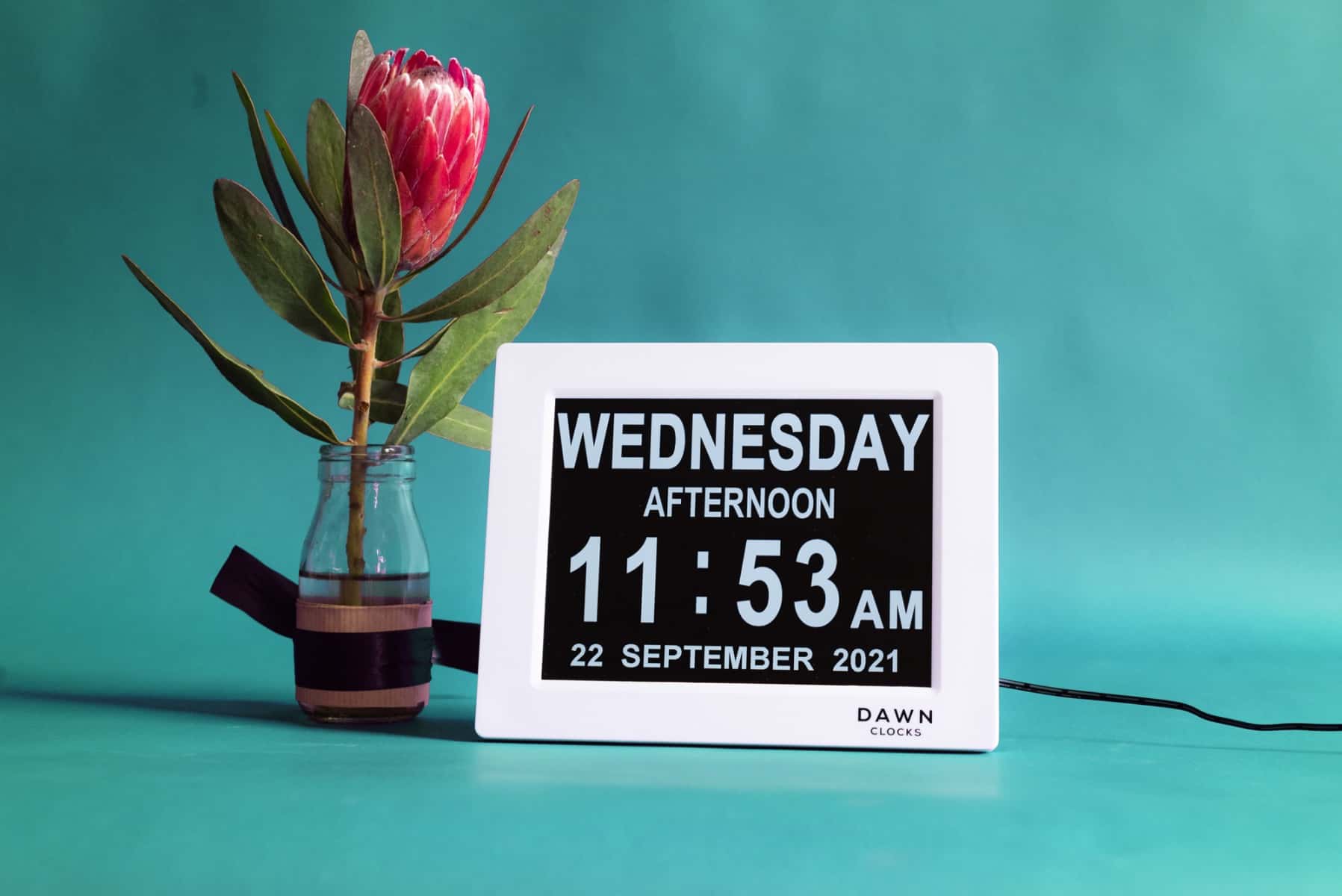
The LED backlit display can show the time – either in 12 or 24-hour format – or showing ‘Now it is Monday morning’. The clock helps maintain a daily routine as it can give instructions like ‘Time for breakfast’ or ‘Time for your medication’.
The dementia clock also features a variety of languages. The language feature is particularly important in dementia, where a person's childhood mother-tongue language tends to be retained the longest and is easiest to work with.
Our dementia, calender & reminder clock has a sleek, modern design, and can be mounted on the wall or left freestanding on the dresser or table. It is also easy to set-up and looks great in any space. The device adjusts the brightness of the display when in day or night mode.
The Dementia Clock, Calendar & Reminder Clock by Dawn Clocks is the perfect time piece to maintain a daily routine and regain independence.
Analogue Talking Clock
When talking about clocks, you should keep in mind that digital clocks became common in the 1970’s. Those born before that decade will sometimes be more comfortable with a traditional analog clock.
This Analogue Talking Clock has a very clear contrast face with large bold numbers on a luminescent background. This timepiece is an easy way of helping users who struggle to read traditional clocks. At the push of a button, the clock will announce the day and time in a clear voice.
It also features an alarm and snooze button. It is also a helpful aid to those with sight limitations.
Talking alarm clock
Talking clocks offer an elegant solution for people with memory loss to maintain independence and avoid confusion. Our talking alarm clock speaks and announces time in a pleasant voice. Just activate the voice announcement with a simple press of the button at the top! It can be pressed whenever your loved one wants to know the time, giving them support during their day or night, even if they have trouble seeing or understanding a traditional analogue or digital clock display.
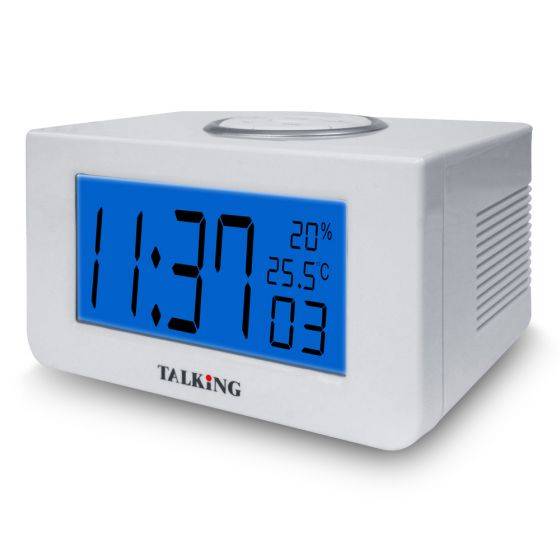
The time is spoken aloud, making this device also ideal for people with poor eyesight. It runs on batteries.
A benefit of the clock is that it also gives the temperature outside.
Conclusion
Disorientation is a distressing part of living with Alzheimer’s and dementia. Helping your loved one to know what time it is, could really affect their self-confidence and their quality of life.
These dementia clocks help them regain some of what they have lost, and clear up any confusion and anxiety.